I have had a long standing debate with a considerably more erudite friend over the origins of the term desert. He argues from his extensive knowledge of linguistics and Latin that the term is derived from the verb to desert, which is predictably descended from the term de-serere, to unjoin. This is, of course, a logical and most likely correct explanation.
I, however, tenaciously hold onto an interesting anecdote related during a 9AM Egyptian Archaeology course. In ancient Egyptian (which, like its modern day cousins Hebrew and Arabic, and descendant Coptic, uses combinations of consonants to express core ideas), the term d-s-r-t described the uninhabitable 'red land' that stood in contrast to the k-m-t 'black land' of the Nile Valley.
I can find no credible explanation of how the Egyptian may have made its way into English, but it is a fun coincidence.
Saturday, December 13, 2008
Desert wording


Monday, October 27, 2008
Deserts and the rise of civilization
Despite centuries of trying to understand just what drove humanity to choose the plow over the atlatl we've only come a little closer to understanding that pivotal moment in our history, and at this point it's safe to say we'll never really know the whole story. The implications of the adoption of agriculture are so profound- for technological and economic change, for societal structure and hierarchy, even for genetic and racial heritage- that to study it is to study human nature. Needless to say, the old 'cradle of civilization' model has been showing its cracks for a while, but the dessicated view from Bikaner leads me to ask: why was it that many of the first states emerged in the most arid environments?
In China, the Middle Kingdom grew around the dry banks of the Yellow River, not the Yangtzee. In India, the Ganges and the Brahmaputra, hosting the greatest agricultural land in the world, lost out to the desert-bound Indus. The arid setting of the Tigris, Euphrates, and Nile are regular features in today's news. And in the New World, complex societies emerged and flourished in New Mexico, the Mesoamerican Plateau, and the Andes rather than in the rich Pacific Northwest or Amazonian rainforest. Why didn't early civilizations emerge in environments optimally suited for agriculture?
In 1957 Karl Wittfogel addressed this quandary, arguing in his 'hydraulic empire' hypothesis that it was the need to regulate and control access to water that led to the first governments, which in turn led to states. I have only been out of school for six months and I already can't recall exactly why his theory fell out of favor, but I think it had to do with the idea of necessary 'stages' of the development of civilization. That, and the title of his book was Oriental Despotism.
There are a few other reasons why deserts might have played a role in the birth of civilization. Rich farmland is also probably rich nomad-land-- for the residents of the Rhine, there was no good reason to look past hunting wild boar. A desert river, on the other hand, might force specialization, leading to a symbiosis between people who maximized the river's potential and others who dropped in on it occasionally. This situation also would drive trade, the great engine of technological development. Once settled, the people on the river would be more likely to adopt agriculture, begin to accumulate wealth, and exhibit the social and economic hierarchies associated with civilization. And once you're on that bandwagon, there's no getting off.
Saturday, October 25, 2008
Music appropriate for desert walks
Lacking any large arid regions of its own, the West's experience with deserts has come only through the lens of other cultures. Whether in the plains of Andalusia, the dunes of southwest Asia, or the pueblos of the American southwest, our view of deserts is tinged with a hint of the exotic. This is obvious with regards to the camel-- how else could such a simple, well-adapted, useful animal be seen as so primitive and foreign?-- but it also holds when we look at western music's portrayal of deserts and their people.
The phrygian modes of Iberian music have lent a 'Spanish Tinge' to jazz, a sound that melts into the semitone scales of the Maghreb and the familiarly stereotyped drums of Africa. Bombastic Arab marches contrast with the honest melodies sung by herders. Epic soundtracks complement the sun-splashed monuments of Utah, and even the tundra gets the balalaika. In western music, the desert is at once overpowering, massive, inspiringly romantic, and simple, foreign, and honest. I like it.
See, for example, Rimsky-Korsakov's Sheherazade, with dissonant harmonies resolving into an unforgettably grand theme. The classic soundtrack to Lawrence of Arabia plays around with the "Turkish March" made famous in Beethoven's 9th Symphony after revealing the famous motif appropriate for its beturbaned hero (note that John William's love theme from Raiders of the Lost Ark, set in arid Egypt, relies on the same hackneyed exotic chord changes as Lawrence's tune). Its composer, Maurice Jarre, exhibits his talent for endlessly repeating a schmaltzy romantic theme in another desert movie, Dr. Zhivago. Elmer Bernstein's rousing The Magnificent Seven and Gabriel Yarre's beautiful but tedious The English Patient show the same trends. And then there is Caravan.
If you can think of more, please send them along!
Wednesday, October 15, 2008
Deserts and chess
Real war, as Robert McNamara so aptly pointed out, is far too complicated to ever be understood by a single person-- hence the term 'the fog of war.' Games are fun because they put the excitement and challenge of strategic competition within the bounds of one individual's intellect. In chess, it is possible (but just barely) to see your will and wit acted out on the board. The number of variables has been reduced to a level where the system lacks the unfathomable complexity of reality.
The desert is a similar system. The dominance of a few variables-- sun, wind, water-- marginalizes all the others. It is simplicity and comprehensibility that grant deserts their beauty, the sublime alternation between life, meaning, and emptiness. In even ten minutes sitting alone in a desert you begin to pick up on cause and effect, on the connections between every element. Soon you start to figure out the patterns of life, and it is only a matter of time before you feel you know the rules so well that you are a part of the game.
Thursday, October 9, 2008
The Thar: Traditional dry farming
Until the advent of large-scale irrigation, the internal combustion engine, and modern health care the residents of the Thar desert had worked out a very stable economic system whose roles and rules were prescribed by a very strict social code. Nomadic castes (such as the oft-mentioned raikas) herded camels, cattle, goats, or sheep across carefully maintained rangelands whose use was carefully regulated by religious authorities. Small farmers relied on rainfall (averaging about 5-10 inches a year) for their small harvest of millet, pulses, and sorghum; the large variation in yield meant that land consolidation was by and large impossible and small villages remained economically independent. In the cities, the ruling and merchant castes found wealth in the taxation of trade, regulating both overland caravans and the access of the small farmers to larger markets.
As this system anticipated aridity, it was much more resistant to temporary environmental change than, say, a riparian culture completely unprepared for the failure of a flood. The entire success of the system, however, depended on the marginal prosperity of farmers, who in turn relied upon scant and erratic rain. The devastation wrought by drought in Bikaner is legendary in city lore.
Here, a typical dry millet farm:

Thursday, October 2, 2008
Deserts and me
The desert is not just a place or environment, nor even, as the cliché goes, a frame of mind. It is a way of viewing life, particularly human life. Turning a desert-tinted lens to our history is like performing a feminist reading of a text or explaining momentum in string theory-- a mere reconsideration of the evidence using different assumptions.
Tuesday, September 30, 2008
The Valley of Death

On Tuesday I hopped an intriguingly barbed-wire fence. Walking in a downwind direction I had no clue what awaited me. Soon I was surrounded by the carcasses of dozens of animals-- cows, camels, dogs, buffalo, everything-- whose decay and reclamation was presided over by massive packs of mangy dogs and enormous congregations of vultures and other large birds. As the stench washed over me and I fingered my walking stick in hopes of never needing to defend myself, I recalled a warning I had ignored several days before.
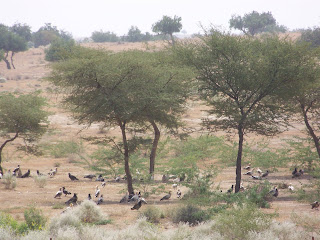
When an animal dies, dalits (untouchables) are called to remove the corpse. After removing anything of value for later processing, they transport the carcass to a designated spot for disposal. It was this city dumping ground I had strayed into. Surrounded by years of decay, the aroma of death filled my lungs and I focused on getting away safely. It was only later that my thoughts turned to the people whose lives are consumed by such business.
